
AI & Innovation Portfolio Innovation Initiatives
03 · What’s next
From opportunity space to prioritized opportunities.
Opportunity framing, prioritization and concept development for internal tools and a high-income banking segment, including an activation that starts with a physical object.
- Role
- Direction of framing and concept development
- Organization
- Capgemini · Applied Innovation Exchange
- Client
- Latin American bank
- Focus
- Opportunity portfolio · Future journeys
01 The work
I directed opportunity framing, prioritization and concept development for initiatives involving internal tools and a high-income banking segment.
The material below is from one of those activations: a physical gift carries a QR code, the code opens a browser experience, the experience collects an idea from the client, and an augmented layer turns the printed piece into something that moves.
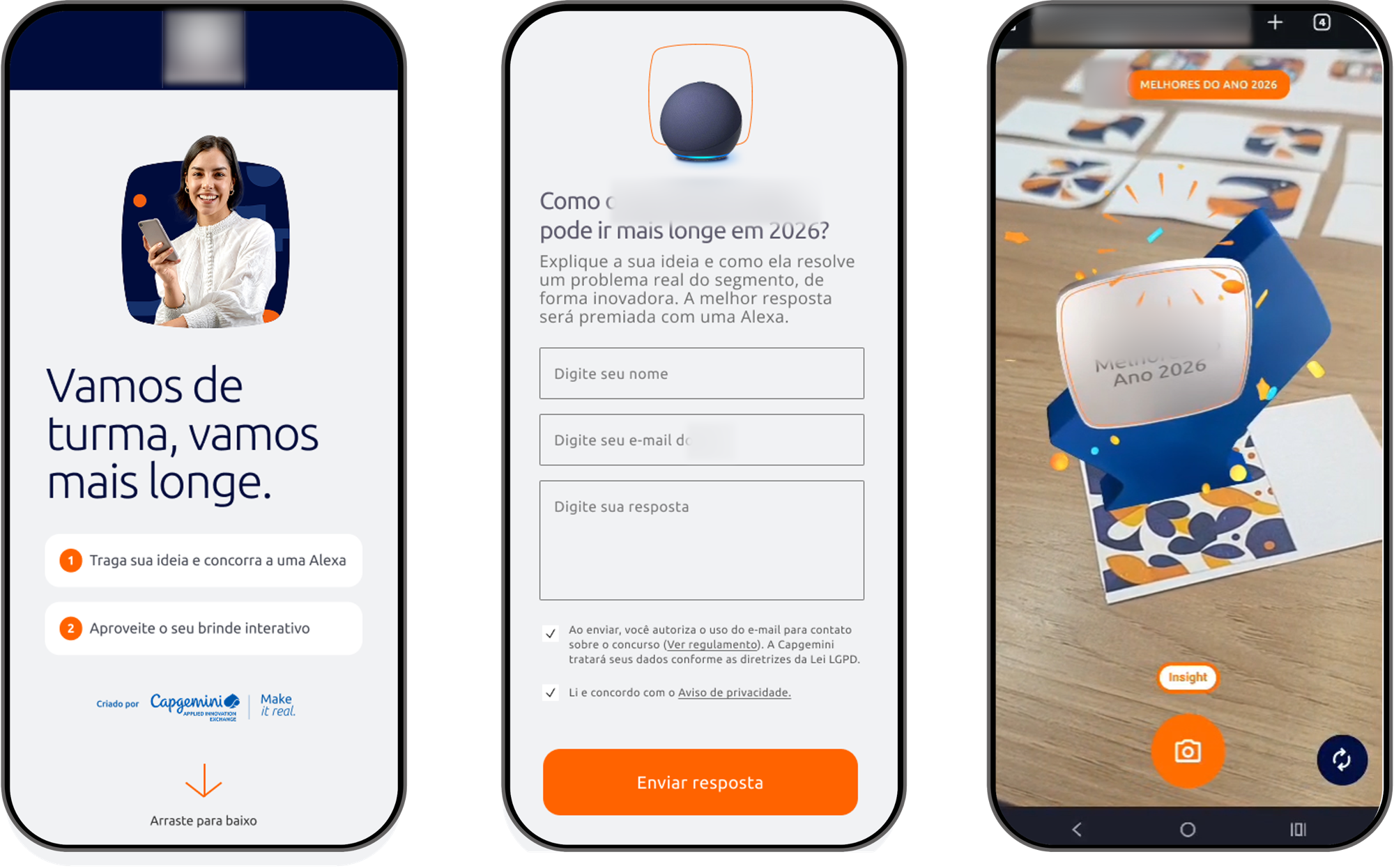


Framing work like this is what makes an opportunity portfolio concrete. A prioritized bet stops being a line in a deck when someone can hold it.
- Opportunity portfolio
- Strategic prioritization
- Future journeys
- Concept direction
02 How I ran it
I framed before we built.
An innovation brief inside a bank usually arrives as a list of ideas. My job was to turn that list into a small number of bets an executive could choose between, and only then to build.
-
I kept the opportunity separate from the solution
I described what was worth doing without describing what could be built. Mixing the two is how organizations end up funding the idea that was presented best rather than the one worth funding.
-
I prioritized as a portfolio instead of a queue
I had the initiatives ranked against each other rather than argued one at a time. Everything sounds worth doing until you place it next to the thing it would displace.
-
I prototyped the moment, not the platform
We built the activation as one continuous moment: a physical gift, a QR code, a browser experience, an augmented layer. That chain is the thing that either works or does not, so that is what we tested.
-
I refused to put an app between the gift and the experience
The augmented layer runs in the browser. An install step between a client and a present is the easiest way to lose them, and it buys nothing the browser could not already do.
Framing is unglamorous and it is where most of the value sits. By the time something is being built, the expensive decision has already been made.